What to do with Blind Shoots
By Robert B. Martin Jr.
April 2015 Reprint from "Rose Ecstasy"
Publication of Santa Clarita Valley Rose Society
Kitty Belendez, Editor
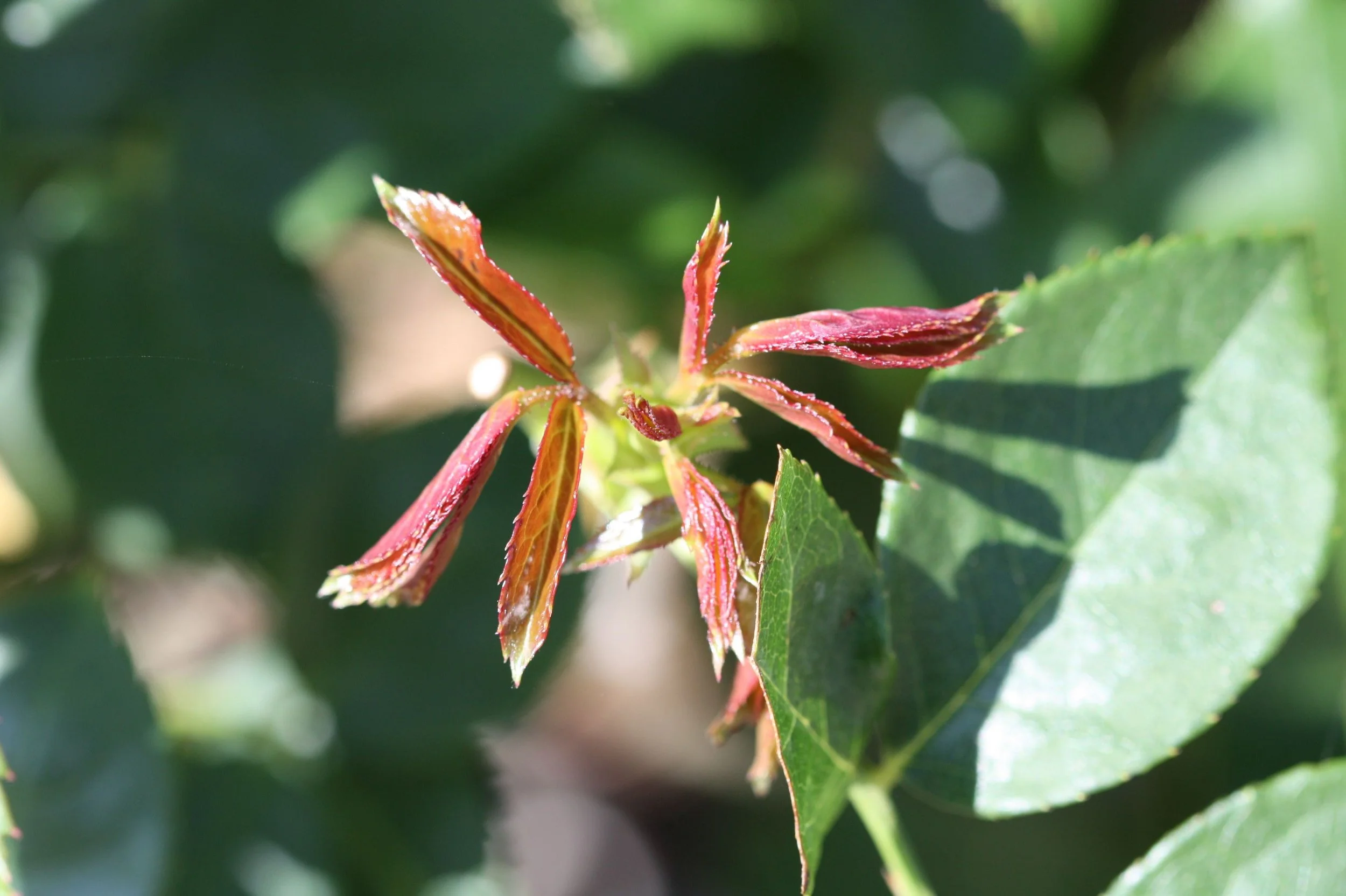
Blind shoots are formed on roses when flower buds do not develop. The result is a stem with no flower at the end.
The reason that blind shoots develop is not well understood. Climate factors, especially those affecting the presence of light, are thought to have an effect. Temperature factors may also be implicated. And others, such as myself, tend to think they occur because the rose is producing more stems than it can support with corresponding blooms. This view is based on my experience that a mild and rainy spring that supports fast and ample foliage growth will produce a large number of blind shoots.
But the purpose of this article is not to explore the reasons for the development of blind shoots nor how their number can be reduced. Instead, its purpose is to address the typical questions that arise after blind shoots are observed. These include “What do you do with a blind shoot?” “Does a blind shoot represent a genetically defective branch?” “Should a blind shoot be removed in its entirely?” And if not, “How and when should a blind shoot be pruned?”
In my years of reading rose literature, I have not seen much attention addressed to these questions. There has been some lore here and there but seemingly without scientific basis. It was therefore with interest that I learned of the publication in late 1995 of an article in Scientia Horticulturae by Niels Bredmose and Jurgen Hansen of Denmark titled “Regeneration, Growth and Flowering of Cut Rose Cultivars as Affected by Propagation Material and Method.” And through the gracious assistance of Dr. David Richardson, Dean of Science at St. Mary’s University in Nova Scotia, I was able to obtain a copy of the article.
The article reports on an experiment conducted over a period of twenty months by the authors in which they compared the effects of propagating flowering versus blind shoots by cutting and grafting on the growth of two different rose cultivars. To the knowledge of the authors, blind shoots had not previously been studied as material for propagation and subsequent cultivation of rose plants.
The two cultivars used were the florist roses KORflapei (‘Frisco’) and Bergme (‘Gabriella’). Both are floribundas available in Denmark but not well known in the U.S. (There is evidence that ‘Frisco’ and the miniflora, ‘Top Contender’ are the same rose, though this is another story.) There were differences in the data between the two roses but this appeared to the authors to reflect the normal difference in the growth behavior of two roses and did not affect their overall conclusions.
At the beginning of the experiment plant material for cutting and grafting was selected by taking material above the first basal five leaflet leaves of both first grade flowering shoots and blind shoots. The plants were then propagated both by cuttings and grafting. The propagated plants were then compared by percentage of survival, bud growth and the length of the shoots developed.
The results are particularly interesting to those who fear that blind shoots are useless. The authors concluded there was no significant difference in rooting percentage for cuttings and scions from blind shoots compared to flowering shoots. Bud growth, initial shoot growth and survival from flowering shoots were somewhat better with one cultivar whereas for the other cultivar the bud growth, initial shoot growth and survival from the blind shoots was slightly higher but not thought to be a significant difference. In non-scientific terms it appears that as far as resultant growth is concerned it doesn’t matter whether the plant is propagated from a flowering shoot or a blind shoot.
Continuing, the authors analyzed the resulting blooms over a period of time and this is where the surprising result occurred. Compared with flowering shoots as propagating material, the use of blind shoots resulted in significant increases in the number of both saleable and second grade blooms. Put again in non-scientific terms this means that the plants propagated from blind shoots produced better blooms.
The reason for this result is not clear but the authors speculate that the larger yield of blooms from blind shoots could be due to the greater number of side buds that develop in blind shoots than in flowering shoots. Roses are known for what is called “apical dominance” which means that the main buds at the tip suppress development of the buds down the shoot. A blind shoot, lacking the terminal bud, does not produce this effect and the authors surmise that the side buds are thus left to develop more freely. This conclusion appears logical to me and I am willing to accept it based on my own experience in growing roses.
Of additional interest, the authors observed that the number of blind shoots produced by the plants was the same as plants originating from blind or flowering shoots. This is to say the blind shoots do not necessarily beget more blind shoots.
So what does this research tell us as rosarians about dealing with blind shoots? Well, first of all, it calls into question the article of faith that the best propagating material for a cutting is a stem from a flowering shoot that has just finished flowering. And for those adept at grafting roses, it indicates that it makes no particular difference if the bud is selected from a flowering shoot rather than a blind shoot.
The results of the research also give an indication of how we should prune blind shoots. There is no reason it appears to remove the entire shoot, in fact the results on flowering suggests that there is great potential in the side buds of a blind shoot.
So what to do? I had concluded prior to reading this article, based solely on experience, that the proper way to treat a blind shoot is to prune or deadhead it as if there had been a bloom there. And now it appears that there is a scientific basis to support this conclusion.
I still don’t know what causes blind shoots and it is somewhat disappointing to grow a stem that fails to produce a bloom. But it appears that the lack of a bloom is about all that distinguishes a blind shoot from a flowering shoot. Indeed the conclusion that the failure of bloom encourages better blooms from the side buds the next few times around is encouraging and removes much of the disappointment. A blind shoot then is simply the stem of the bloom you never saw and is not much to worry about.
Reprinted with permission.